
'From data on enquiries, we can build what we call a data lake or a data warehouse where data is classified into various cohorts and then we use AI and ML tools to predict demand down the line.'

'We will have multiple engine options -- electric vehicle and internal combustion engine in diesel and petrol.'

So far this year, around 839,545 electric vehicles have been sold, accounting for approximately 6.69% of the total 12,541,684 vehicles sold.

Homegrown auto major Tata Motors on Tuesday said it will raise $1 billion (Rs 7,500 crore) in its passenger electric vehicle business from TPG Rise Climate at a valuation of up to $9.1 billion. Tata Motors Ltd (TML) and TPG Rise Climate, the dedicated climate investing strategy of private investment firm TPG, have entered into a binding agreement in this regard. Under the agreement, TPG Rise Climate along with its co-investor ADQ, will invest in a subsidiary of Tata Motors that will be newly incorporated, the company said in a statement.

Tata Motors, India's third largest passenger vehicle maker, took pole position in the competitive sport utility vehicle (SUV) market in October, reveals the data from industry sources. Riding high on the Punch - the sub-compact SUV offering launched on October 18 - the Tata group flagship sold a record 23,381 units in October, higher than 20,022 units sold by archrival Mahindra & Mahindra, 18,538 units sold by Hyundai Motor India, and 15,931 units sold by Kia Motors India. Utility vehicles - that include SUVs and multipurpose vehicles - accounted for almost one in every two passenger vehicles sold in India in the first seven months of the current financial year, according to the Society of Indian Automobile Manufacturers.

Tata Motors is looking at various measures, including direct buying from stockists and making changes in the product configurations, to offset the impact of semiconductor shortage on its production activities and sales, a top company official has said. The auto major, which sells models including Nexon, Harrier and Safari in the domestic market, is also looking at different kinds of chips which could be used in components where the supply situation is severe. The automaker expects the situation to remain challenging in the ongoing quarter and some improvement in supplies only in the second half of the fiscal.

'He was a practical person who ensured that he thought about the common man, animals, the fact that they have a life and they have to be respected.'

The 2024 Kia Sonet facelift impresses with its comprehensive upgrades, ranging from a refreshed exterior design to advanced safety and technological features.

If electric cars with a real range of more than 400 km are launched, the anxiety regarding the charging points will come down, and more people will buy EVs.

Car sales are experiencing a challenging phase with around Rs 60,000 crore worth of inventory lying unsold with dealers.

DRS to be used in IPL this year: Rajeev Shukla

The design of the rear doors and C-Pillar for example seem inspired by the Suzuki iv-4 concept crossover.

Tata Motors is looking to ramp up the production of electric vehicles as demand continues to outpace the manufacturing activity by a huge margin, according to a top company official. The Mumbai-based automaker, which led the passenger electric vehicle space in the domestic market in last fiscal year, has been receiving an average of 5,500-6,000 bookings in the past two months for its EV range. The company sells three electric products -- Nexon EV, Tigor EV and XPRES-T -- in the domestic market.
The business will also see a change of guard. Shailesh Chandra, president of EV and corporate strategy, will replace Mayank Pareek as president of PV business, including EV, with effect from April 1. Pareek will be superannuating from the company after a six-year stint at the end of February 2021. Chandra and Pareek will work on transition over the next few weeks.
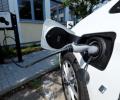
Tata Motors is planning to invest Rs 15,000 crore in the EV segment in the next five years, a top company official has said. The company, which is a leader in the newly emerging EV segment with offerings such as Nexon, is also planning to develop around 10 more new offerings in the segment, president for Passenger Vehicles Business of Tata Motors Shailesh Chandra said. "As far as future is concerned, in next five (years) we will invest Rs 15,000 crore in electrification.

Homegrown auto major Tata Motors on Wednesday unveiled a concept compact sports utility vehicle Nexon along with another concept car ConnectNext.
Tata Motors plans to have 10 new battery electric vehicles (BEVs) in its domestic product portfolio by 2025 as it looks to drive its business model towards sustainable mobility going ahead, as per Tata Motors chairman N Chandrasekaran. In his message to the shareholders, he noted that the auto major aims to be amongst the world leaders in sustainable mobility solutions and as part of that it is also exploring tie-ups in cell and battery manufacturing to secure supplies for its portfolio of green vehicles. "In India, EV penetration in our portfolio has now doubled to 2 per cent this year and we expect penetration to increase exponentially in the coming years. "Tata Motors will lead this change in the Indian market. By 2025, Tata Motors will have 10 new BEV vehicles and as a Group, we will invest proactively to set up charging infrastructure across the country," Chandrasekaran informed shareholders in the company's Annual Report for 2020-21.

A digital configurator comprising a three-dimensional graphics-based app will allow customers to choose specifications and align the output generated by the tool to company's back-end manufacturing.

Passenger vehicle sales are expected to experience muted growth in the current financial year.

Tata Motors plans to showcase over 20 passenger and commercial vehicles at the upcoming Delhi Auto Expo.

The list includes compact SUV, mini SUV, premium hatchback and premium MPV.

The company, which rents cars by the hour, day, week and month, has Mahindra E2O Plus and Tata E Tigor available on the platform for which it charges a subscription fee of Rs 15,000-20,000 per month.

In the first 4 months of CY17, Honda has sold 14% more units than Tata Motors

The push given to rooftop solar installation in the Interim Budget ties in with its high rate of adoption in Tier-II and -III cities of India. If original equipment manufacturers (OEMs) in the automobile industry, government, and the solar sector are to be believed, in cities of Rajasthan, Gujarat, and Kerala, 45-50 per cent of electric-vehicle (EV) users are employing rooftop power to charge their vehicles. This is compared to the national average of 25 per cent, say industry sources.

Dealers of Tata Motors in most parts of the country have stopped placing orders for this small car in the last three-four months and the showrooms are displaying contemporary models such as Tiago, Tigor, Hexa and Nexon.

Tata Motors aims to address 95% of passenger vehicle market by 2020

Be it the name, the design and communication campaign and the engagement processes being imagined between the brand and its buyers, the company is casting its cars in a new mould, reports T E Narasimhan.

For players like Toyota Kirloskar and Ford, the contribution of UVs to overall sales is now well over 60%.

Close to 50 models were launched in India in the past 12 months, but companies have not been able to realise their potential due to the pandemic.

The Mumbai headquartered company also overtook Japanese carmaker Honda to occupy the fourth spot in domestic passenger vehicle market.

The company is banking on investments lined up for product development and other innovations.

Among the cars unveiled at the Auto Expo on Wednesday was Mahindra and Mahindra's e-KUV for Rs 8.2 lakhs ex-showroom Delhi. With a single charge range of 150 km and a 55 min fast charging upto 80 pc, it was both a head-turner and a conversation-starter.

Only five of India's top 20 car models have seen a reduction in wait times over the past year.

From the customer point of view too, LFP batteries are safer and offer a longer life.

Trend researchers who come from design schools and have an art and sociology background are the latest foot soldiers in the struggle of auto companies to stay ahead in the competitive race.

In the two wheeler segment, TVS Motor Company reported a 24 per cent increase in total sales at 304,795 units in April.

The company, which on Wednesday launched its compact sedan Zest in the NCR, priced between Rs 464,000 and Rs 699,000 (ex-showroom Delhi), is also working to upgrade its sales and service network.

First off the block will be a new multi-purpose vehicle which is being co-developed with Toyota - Suzuki's alliance partner. The model will also wear a Toyota badge.

The government on Friday approved an electric-vehicle policy, under which duty concessions will be given to companies setting up manufacturing units in the country with a minimum investment of $500 million, a move aimed at attracting major global players like US-based Tesla. According to an official statement, the companies setting up manufacturing facilities for e-vehicles will be allowed to import a limited number of cars at lower customs duty. The policy seeks to promote India as a manufacturing destination for EVs and attract investment from reputed global EV manufacturers, it added.

A lot rides on this new vehicle for Renault, the seventh largest player in domestic passenger vehicle market, as its brand new SUV takes on Maruti Suzuki Brezza, Hyundai Creta and Ford EcoSport.
